
The tradition behind Kesh Amrit
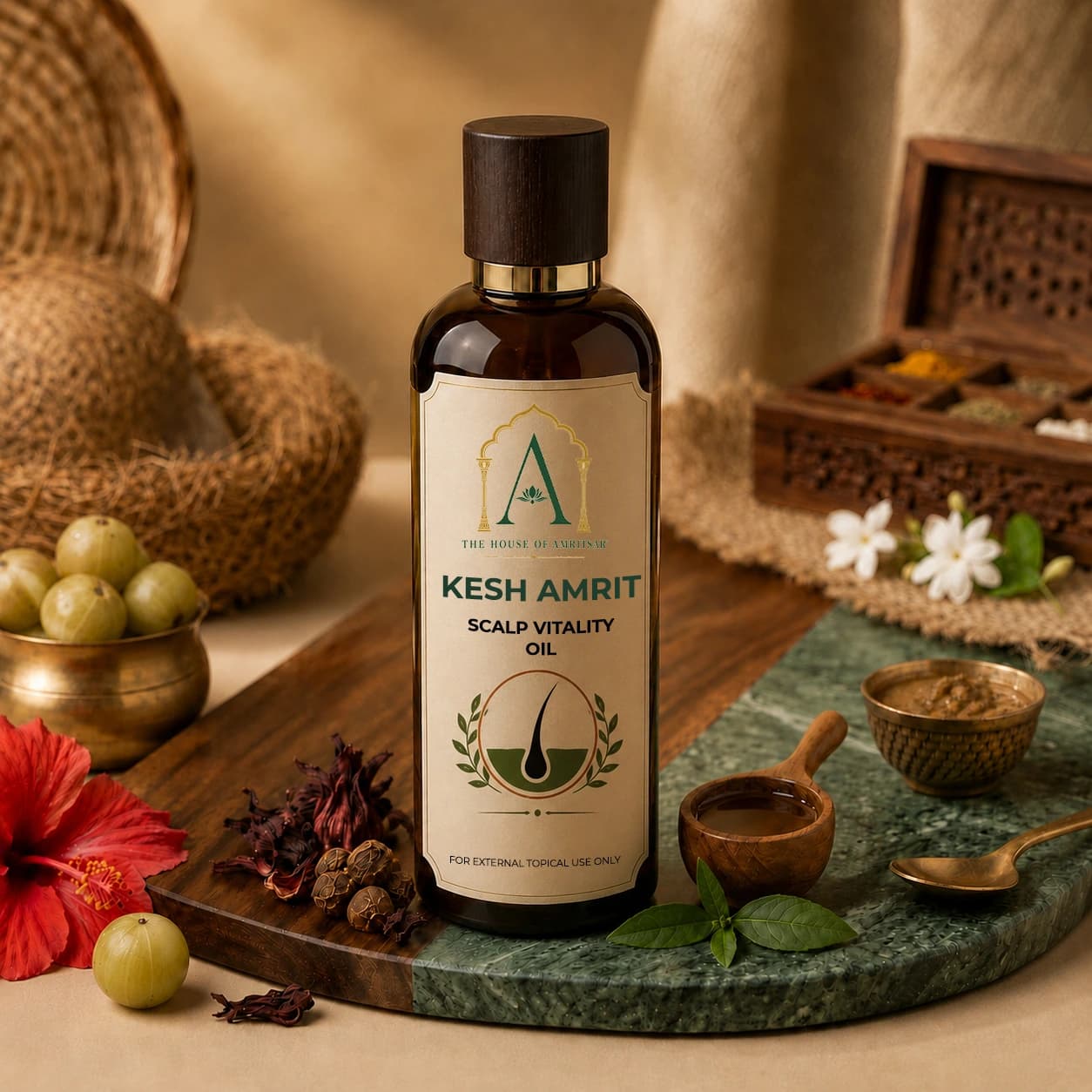
Kesh Amrit takes its cue from champi — the head-massage and pre-wash oiling ritual practised across Punjab and much of North India, where a warmed oil is worked into the scalp and left to sit before washing. It is one of the most domestic of all the traditions the House draws on: an ordinary weekly act in Amritsar households rather than a salon service. The concept keeps that unhurried, generously-applied character rather than reframing it as a leave-in styling product.
Why these botanicals
- Bhringraj
- The single material most closely identified with Indian hair-oiling tradition, described in Ayurvedic literature as a keshya or hair-associated herb. It anchors the concept and is the reason this is a scalp oil rather than a general body oil.
- Amla
- Indian gooseberry, a traditional rasayana fruit that has been infused into Indian hair oils and powders for generations. Included for the conditioning and grooming identity it carries in that tradition.
- Neem
- Chosen for the balancing, purifying role it plays in classical scalp preparations — the reason this concept is framed for scalps that feel oily rather than for dry scalps, where Brahmi & Shikakai is the intended counterpart.
- Brahmi
- A cooling, calming material in the classical texts, used here to temper the sharper green character of Neem so the finished oil suits a long, slow massage.
- Coconut Oil
- The traditional carrier for hair-oiling across South Asia, giving the concept its pouring weight and its ability to be warmed and spread through sections of hair.
How the ritual is intended to work
In a treatment room the oil is intended for a full champi sequence: warmed, sectioned through the scalp and worked in with sustained fingertip pressure over fifteen to twenty minutes, before the client showers. At home the same oil is intended for a slower weekly application left in place for an hour or more. Because it is a pre-wash oil rather than a leave-in, the professional and domestic versions of the ritual differ mainly in massage time.
Texture, aroma and finish
Envisaged as a medium-weight, freely-pouring oil that warms readily between the palms — heavier than a hair serum, lighter than a set balm. The aroma profile is green and slightly bitter from the Neem and Bhringraj rather than sweet or floral, which is characteristic of traditional Indian scalp oils and deliberately not masked.
Format and presentation
Intended as a bottled pouring oil suitable for both retail shelf and professional back-bar decanting. Final pack size and closure are still under review, and will be shaped partly by trade feedback on treatment-room practicality.
Suitability and safety
Shaped for adult scalps that feel oily or unbalanced, and for fine-looking hair. Intended for external topical use on the scalp and lengths only. As with every concept in the collection, a patch test ahead of first use is advised, and the finished formulation will carry a full INCI declaration and allergen information once the UK cosmetic safety assessment is complete.
More on ingredients, patch testing and the UK safety pathway is set out in the FAQ and the Knowledge Centre.